Third-party app (OAuth / OIDC)
Logto's third-party application integration enables you to leverage Logto as an Identity Provider (IdP) for external applications.
An Identity Provider (IdP) is a service that verifies user identities and manages their login credentials. After confirming a user's identity, the IdP generates authentication tokens or assertions and allows the user to access various applications or services without needing to log in again.
Unlike the applications you created in the Integrate Logto into your application guide that are developed and fully controlled by you, third-party applications are independent services developed by external developers or business partners.
This integration approach is well-suited for common business scenarios. You can enable users to access partner applications using their Logto accounts, just like how enterprise users sign in to Slack with Google Workspace. You can also build an open platform where third-party applications can add "Sign in with Logto" functionality, similar to "Sign in with Google."
Logto is an identity service built on the OpenID Connect (OIDC) protocol, providing both authentication and authorization capabilities. This make integrating an OIDC third-party app as straightforward as traditional web application.
Thus due to OIDC builds upon OAuth 2.0 adding an authentication layer, you can also integrate third-party app using OAuth protocol.
Two ways to onboard a third-party app
- Register the app in Logto (this guide): you create the application and configure its permissions and redirect URIs. Use it when you know your partners.
- Dynamic app: clients connect without pre-registration, using a public HTTPS URL that serves their own metadata document as the client ID. Use it when any client may connect, such as MCP clients and AI agents.
Both can be used at the same time.
Create a third-party application in Logto
- Go to Console > Applications.
- Click on the "Create application" button. Select "Third-party app" as the application type and choose one of the following integration protocols:
- OIDC / OAuth
- Select an application type based on the third-party application's type:
- Traditional Web: Server-rendered applications (e.g., Node.js, PHP, Java) that can securely store a client secret on the backend.
- Single Page App (SPA): Client-side rendered applications (e.g., React, Vue, Angular) that run entirely in the browser and cannot securely store secrets.
- Native: Mobile or desktop applications (e.g., iOS, Android, Electron) that run on user devices.
- Enter a name and description for your application and click on the "Create" button. A new third-party application will be created.
All created third-party applications will be catalogued on the Applications page under the "Third-party apps" tab. This arrangement helps you distinguish them from your own applications, making it easier to manage all your applications in one place.
To restrict which users can sign in to a third-party application, configure app-level access control on the application's Rules tab.
Integration guide
Find the application configurations
On the application details page, you can find the Client ID, Client secret (for traditional web apps only), and OIDC endpoints needed for integration.
If the third-party service supports OIDC discovery, simply provide the Discovery endpoint. Otherwise, click Show endpoint details to view all endpoints including authorization endpoint and token endpoint.
Integrate with services that support third-party IdP
If you're connecting a service or product that natively supports external identity provider configuration (e.g., enterprise SaaS platforms, collaboration tools), the setup is straightforward:
- Open the service's IdP or SSO configuration page.
- Copy the Client ID (and Client secret if required) from Logto and paste them into the service's configuration.
- Provide the Discovery endpoint if the service supports OIDC auto-discovery, or manually copy the Authorization endpoint and Token endpoint.
- Copy the Redirect URI from the service's configuration page and add it to your Logto application's allowed redirect URIs.
- Configure the scopes if the service allows. Since Logto is an OIDC provider, include the
openidscope if you need to authenticate users (grants access to an ID token and the UserInfo endpoint). Theopenidscope is optional if you only need OAuth resource access.
The service will handle the OAuth / OIDC flow automatically once configured.
Integrate via OAuth / OIDC protocol
If a third-party application needs to integrate with Logto as an IdP programmatically, it should implement the standard Authorization Code Flow. We recommend using an OAuth 2.0 / OIDC client library for your programming language to handle the implementation.
- Traditional web
- Single page app / Native
Traditional web applications are confidential clients that can securely store a client secret on the backend server. See Authorization Code Flow for full implementation details.
Key steps:
- Initiate authorization: Redirect user to Logto's authorization endpoint with
client_id,redirect_uri,response_type=code, andscope. - Handle callback: Receive the authorization
codefrom the redirect. - Exchange tokens: From your backend, POST to token endpoint with the code,
client_id, andclient_secret.
Single page apps and Native apps are public clients that cannot securely store secrets. Instead of using a client secret, these applications must use PKCE (Proof Key for Code Exchange) for secure authorization. See Authorization Code Flow and PKCE for full implementation details.
Key steps:
- Generate PKCE parameters: Create a
code_verifierand derivecode_challenge(SHA-256). - Initiate authorization: Redirect user to authorization endpoint with
code_challengeandcode_challenge_method=S256. - Handle callback: Receive the authorization
codefrom the redirect. - Exchange tokens: POST to token endpoint with the code and original
code_verifier.
Integrate via device flow
For native third-party applications running on input-limited devices (e.g., smart TVs, game consoles, CLI tools), the standard redirect-based authorization code flow may not be feasible. In these cases, the application can use the OAuth 2.0 Device Authorization Grant instead.
With device flow, the device displays a user code and a verification URL. The user visits the URL on a separate device (phone, laptop), enters the code, and completes authentication there. The device polls Logto's token endpoint until the authorization is complete.
Before implementing device flow, make sure to configure the required permissions for your third-party application in the Logto Console. Third-party apps requesting non-enabled scopes will be denied access.
See the Device flow quick start for full implementation details.
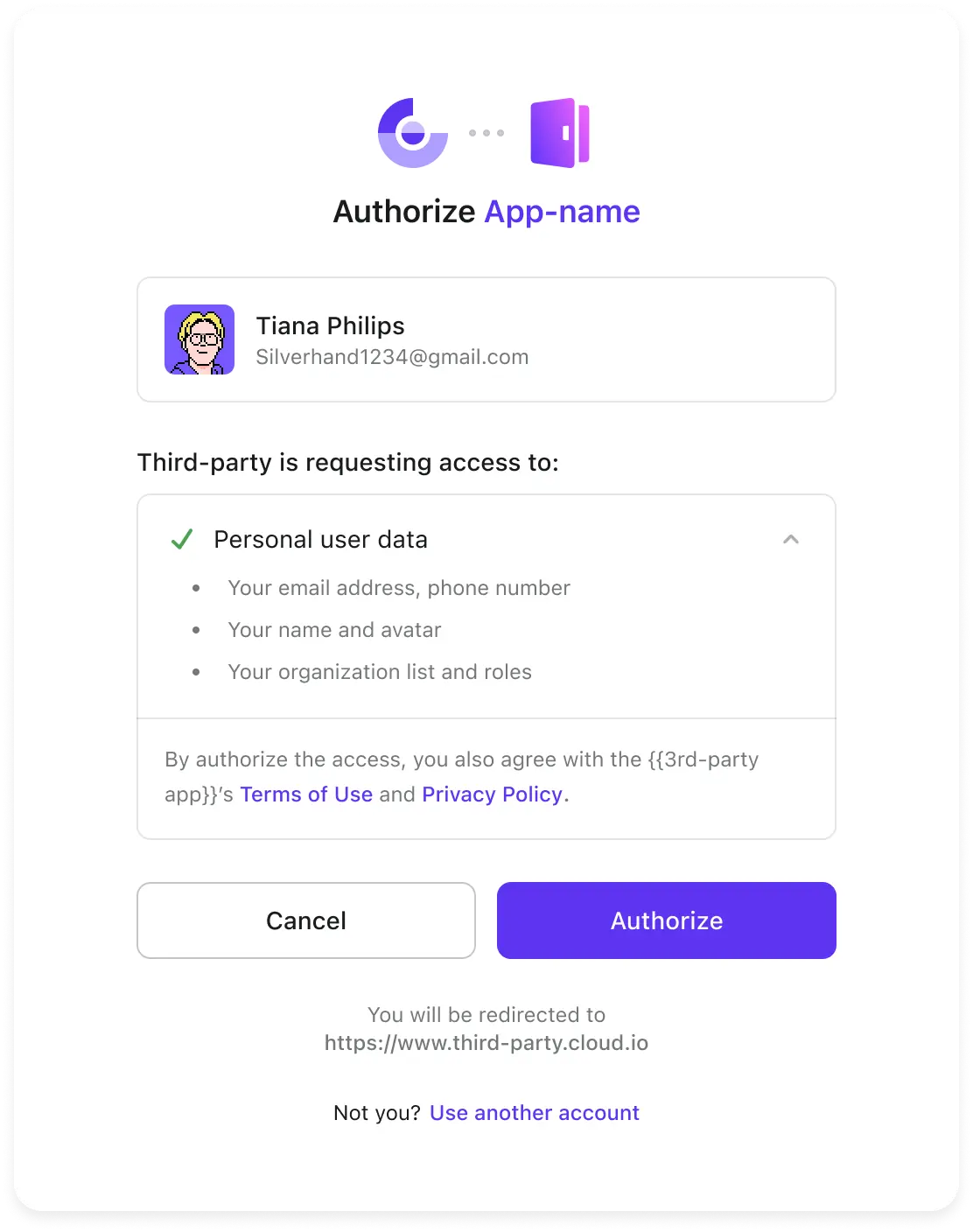
Consent screen for OIDC third-party applications
For security reasons, all the OIDC third-party applications will be redirected to a consent screen for user authorization after they are authenticated by Logto.
All the third-party requested user profile permissions, API resource scopes, organization permissions, and organization membership information will be displayed on the consent screen.
These requested permissions will be granted to the third-party applications only after the user clicks on the "Authorize" button.
Further actions
Learn how to manage permissions for your OIDC third-party application.
Personalize the consent screen appearance to match your brand identity and provide a consistent user experience.
Allow OAuth clients to connect without pre-registration, using a client ID metadata document URL as their client ID.
FAQs
How do we ensure users can only grant permissions they actually have on the consent screen?
Logto uses Role-Based Access Control (RBAC) to manage user permissions. On the consent screen, only scopes (permissions) already assigned to the user—through their roles—will be displayed. If a third-party app requests scopes the user doesn’t have, those will be excluded to prevent unauthorized consent.
To manage this:
- Define global roles or organization roles with specific scopes.
- Assign roles to users based on their access needs.
- Users will inherit scopes from their roles automatically.
Related resources
Use case: Integrate Apache Answer to launch a community for your users
Using Logto as an third-party identity provider (IdP)